Home / Capabilities
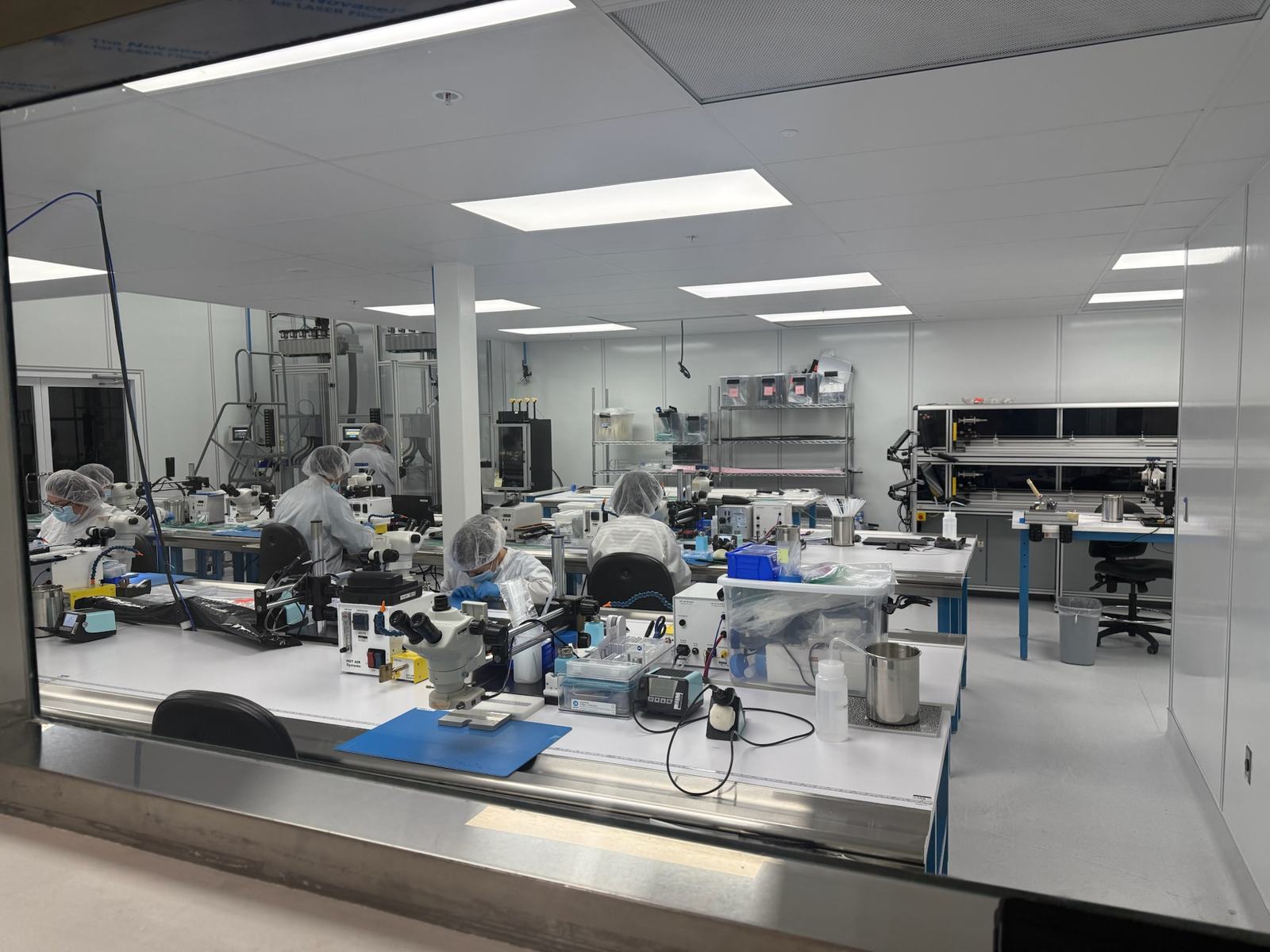
Nine catheter product types in active production in a Class 10,000 cleanroom, across cardiovascular, neurovascular, peripheral, pulmonary and radial access indications.
In-house production with the associated engineering experience available on your program.
Built in house
Listed by product rather than by indication. Each entry states the primary engineering constraint and the process steps performed in house.
Small-lumen distal access through tortuous anatomy. The stiffness gradient from shaft to distal tip decides whether the device tracks or prolapses, and at thin wall the lumen still has to stay open through tight bends. Assembled under magnification, in fixtures that hold concentricity through cure.
Built to back up a guidewire and cross what the wire alone will not. Column strength to advance and push through resistance, without giving up the flexibility to follow the vessel. Tip and transition design is where these are won or lost.
Carrying a therapy to the target and releasing it predictably. Lumen integrity along the full working length, repeatable deployment, and enough push transmission that a long shaft does not buckle before the tip moves.
The stable path everything else travels through. One-to-one torque response from hub to tip, back-up support at the ostium, and a lumen large enough to work through without sacrificing wall integrity.
A guide catheter with an inflatable balloon for proximal flow arrest. Everything a guide has to do, plus a bonded balloon, a separate inflation lumen and joints that stay leak-tight through inflation cycles. One of the more demanding constructions we build.
Built for ingestion under vacuum. Maximum lumen at minimum profile, and a distal end that stays open rather than collapsing when suction is applied. Lumen-to-wall ratio is the governing design constraint.
Access and a working channel in one device. A dilator-to-sheath transition that does not catch on entry, hemostasis that holds through a long procedure, and an inner diameter that stays usable at a profile the vessel tolerates.
Shaped tips that reach and seat reliably, torque that responds one-to-one, and shape retention after repeated manipulation and reshaping. These ship in volume, so assembly repeatability is a cost question as much as a quality one.
Access devices for both sides of the circulation. Atraumatic tip geometry, dependable hemostasis, and constructions built for consistent, repeatable assembly at volume.
Coverage at a glance
Devices matching a row are within current production experience. Adjacent constructions frequently share process steps and should be scoped directly.
| Product | Cardiovascular | Neurovascular | Peripheral | Pulmonary | Radial access |
|---|---|---|---|---|---|
| Microcatheters | No | Yes | No | No | No |
| Support catheters | No | Yes | Yes | Yes | No |
| Delivery catheters | Yes | No | Yes | Yes | No |
| Guide catheters | No | Yes | No | No | Yes |
| Balloon guide catheters | No | Yes | No | No | Yes |
| Aspiration catheters | No | Yes | No | No | Yes |
| Guide sheaths | Yes | No | Yes | No | No |
| Diagnostic catheters | No | Yes | No | No | Yes |
| Arterial and venous catheters | No | Yes | No | No | No |
By body area
What we actually do to a device
Process steps performed between released design and packaged device. Coating and cure are detailed separately below.
| Capability | What it covers | Where |
|---|---|---|
| Concept to prototype | Turning a physician's concept or a napkin sketch into hardware you can hold and test. | Phase 1–2 |
| Complex catheter design | Shaft construction, transitions, tip geometry, lumen layout and hub design for the target anatomy. | Phase 1–3 |
| Design for manufacturability | Making a working prototype into something technicians can build repeatably from real supply-chain parts. | Phase 3 |
| Adhesive bonding & UV cure | Bond joint design, controlled dispensing, UV spot cure at the joint, and fixturing that holds geometry through cure. | Cleanroom |
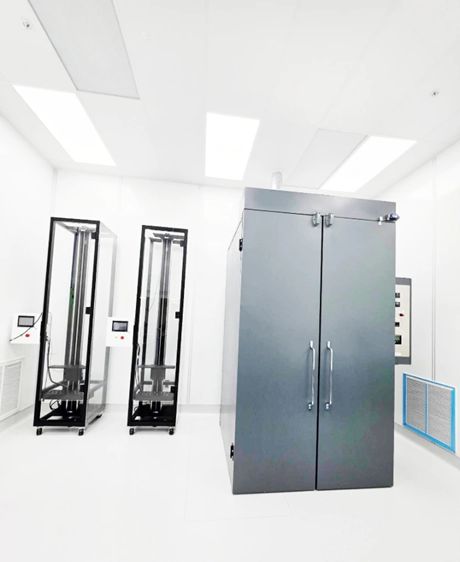
| Lamination & reflow | Large-format oven for lamination, reflow and thermal coating cure across full working-length assemblies. | Oven |
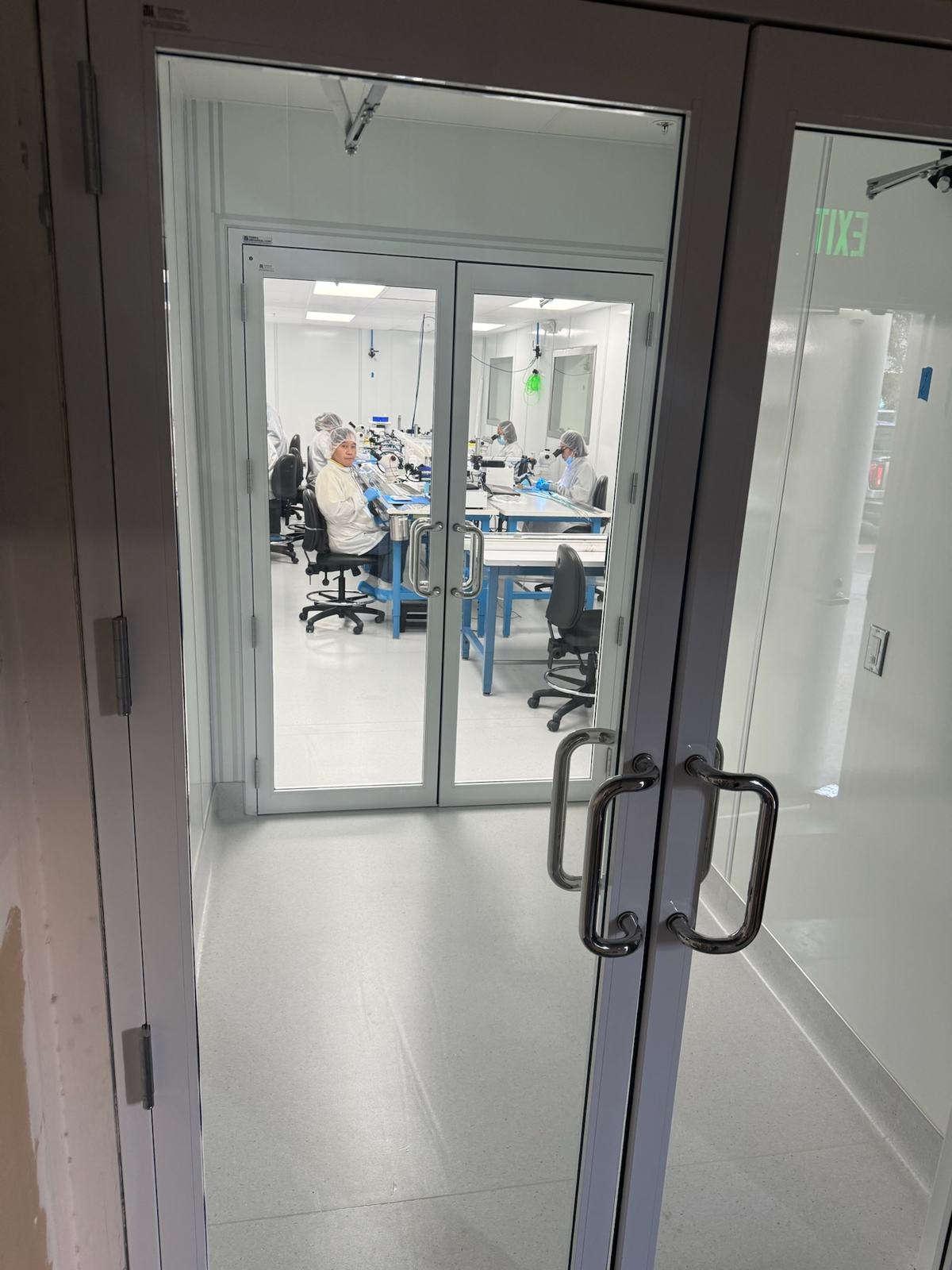
| Cleanroom assembly | Microscope-level assembly of finished devices by trained medical device technicians. | Class 10,000 |
| Braiding | Automated, programmable braiding for braid-reinforced shaft constructions — consistent pick count and pattern across a build. | Automated |
| Laser inspection | Automated laser inspection for dimensional verification and defect detection, performed without contacting the device. | Automated |
| Dimensional verification | LaserLinc Triton 330 non-contact laser micrometry for OD and ovality, logged rather than hand-recorded. No contact means no deformation of soft tubing. | LaserLinc |
| Packaging & seal verification | Sterile barrier pouch sealing inside the cleanroom, with seal peel and integrity testing. | Cleanroom |
| Leak & integrity testing | Lumen and joint integrity on in-process and finished assemblies. | At bench |
| V&V and clinical builds | Verification, validation and clinical-quantity builds under the ISO 13485 quality system. | Phase 4–5 |
Hydrophilic coating
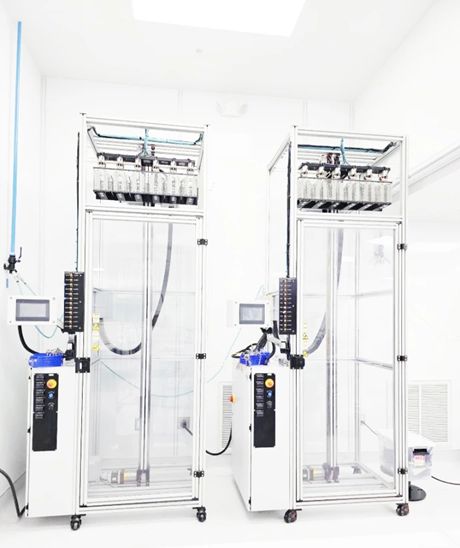
Coating is commonly outsourced, making shipping cycles the rate limiter on lubricity and durability iteration. All three steps are performed on site: two automated dip-coating systems, a large-format lamination and reflow oven, and coated device testing.


All four steps are performed within the classified space, eliminating inter-facility transfer and the associated schedule and traceability exposure.
On the following device types, coating performance governs whether the device reaches the target.
The other on-site step
Track, deployment and retraction behavior evaluated before design freeze, with the responsible engineer present.
Issues identified at the bench are corrected within hours; the same issues identified during a clinical build affect the program schedule.
Next
Concept to clinical build on a gated path with named milestones. Most programs join at phase 3, when a working prototype cannot yet be manufactured.
See the phases → SPACEStart with one subassembly, or take benches and a private room. Staffed by our technicians or your own, for a single build or as long as the product runs.
Space, staffing & terms → EQUIPMENTEvery piece of equipment, utility and logistics capability in the building — and an honest list of what is not.
Check your process →Discuss your device
Include indication, construction and the specific technical constraint. Responses are written by engineering staff with experience in the relevant device type, including where the requirement falls outside current capability.
17151 Gillette Ave, Irvine, CA — 8 minutes from John Wayne Airport
Mon–Fri, 8:00 AM – 4:30 PM PT
Device inquiries submitted here receive a response by the next business day.